
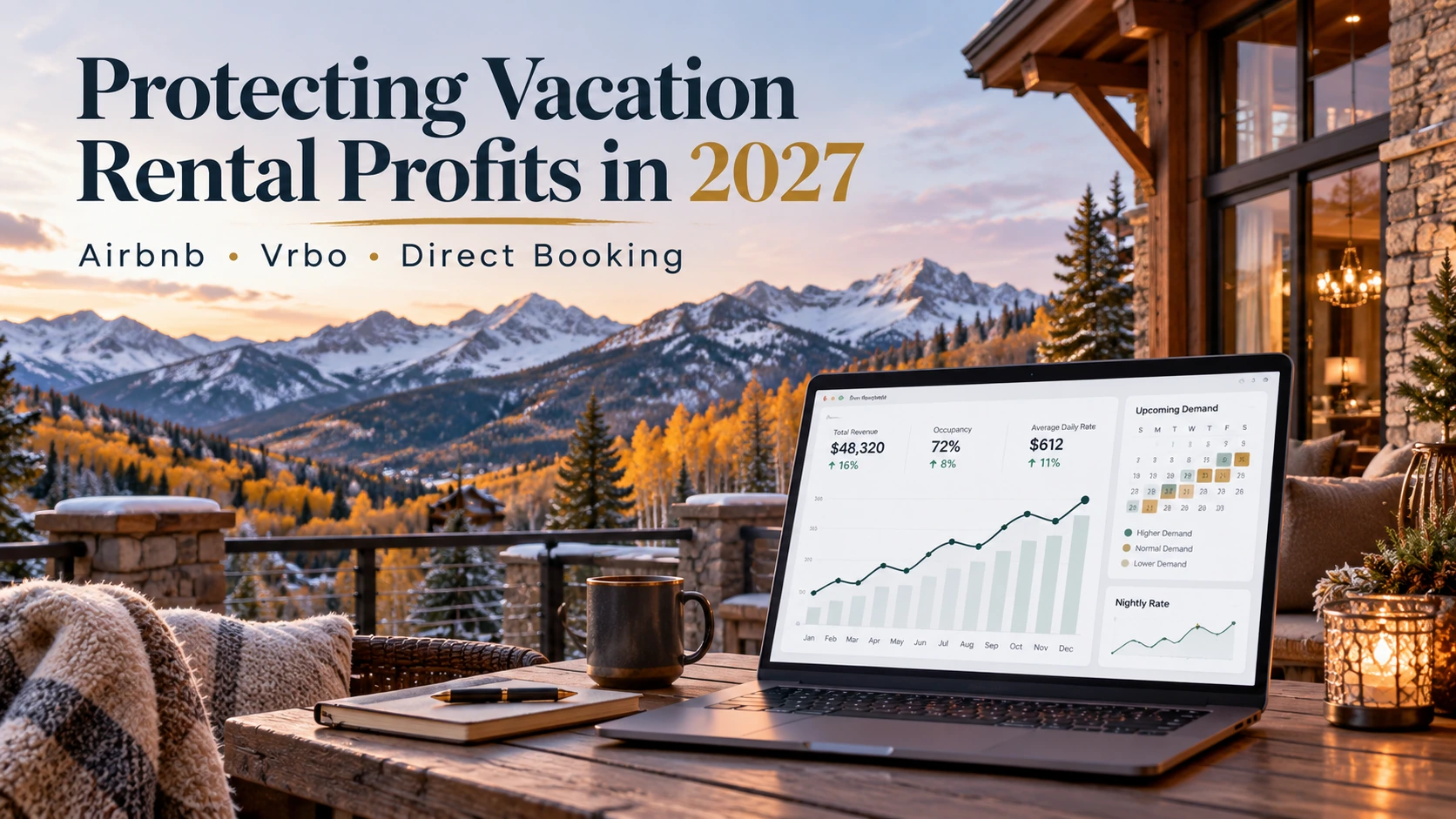
If you own a vacation rental in Colorado, 2027 is shaping up to be a year where profitability matters more than ever. Many homeowners naturally focus on occupancy and nightly rate, but those numbers alone do not tell the full story. A property can look busy on the calendar and still underperform financially if platform fees, discounting, and poor channel strategy are quietly reducing the owner’s bottom line.
That is why vacation rental owners need to pay closer attention not just to bookings, but to net revenue after distribution costs.
For many years, platforms like Airbnb and Vrbo have been incredibly valuable for generating demand. They put your property in front of millions of travelers and make online booking easy. But the tradeoff has always been cost. As platform fees increase and competition grows, homeowners need a smarter strategy to protect profits without damaging occupancy.
Why rising platform fees matter
Most owners are familiar with the idea that Airbnb and Vrbo charge fees, but not every owner fully understands how much those costs affect final payout.
A booking that looks strong at first glance can become much less attractive after platform commissions, promotions, processing costs, and discounts are taken into account.
That matters even more in mountain markets like Summit, Eagle, Lake, Park, Jefferson, and Pitkin counties, where demand can fluctuate based on weather, ski conditions, seasonality, and economic pressure on travelers.
If winter demand softens or guests become more price-sensitive, owners may feel pressure to lower rates at the very same time that distribution costs are rising.
In that environment, the wrong pricing decision can hurt twice:
- You earn less because of higher platform costs.
- You earn even less if you discount too aggressively.
Gross revenue is not the same as owner profit
One of the biggest mistakes vacation rental owners make is looking only at gross booking revenue.
For example, a $1,000 booking may appear better than a $940 booking. But that is not always true.
If the $1,000 booking comes through a higher-cost channel and the $940 booking comes through a lower-cost direct channel, the owner may actually keep more money from the smaller booking.
That is why the real question should be:
How much does the owner keep after fees, promotions, and channel costs?
In 2027, smart STR owners will need to evaluate:
- Occupancy
- Average daily rate (ADR)
- Booking pace
- Channel mix
- Guest acquisition cost
- Net revenue after commissions
That is the difference between simply being booked and actually being profitable.
Why direct booking matters more now
As OTA costs rise, direct bookings become more valuable.
A strong direct-booking strategy can help owners:
- Reduce dependence on third-party platforms
- Keep more of each reservation
- Encourage repeat stays
- Strengthen the long-term value of the property as a business
That does not mean owners should abandon Airbnb or Vrbo.
Those platforms are still extremely important. In fact, for most vacation rentals, they remain among the strongest tools for acquiring first-time guests.
The better strategy is:
Use Airbnb and Vrbo to get discovered. Use direct booking to improve long-term profitability.
A balanced channel strategy often works best:
- Airbnb and Vrbo help generate visibility and first bookings.
- Direct booking helps retain repeat guests and improve margins.
- Professional management helps coordinate the right pricing and channel mix.
Five ways Colorado vacation rental owners can protect profits in 2027
1. Focus on net revenue, not just occupancy
A full calendar is not the goal if it is achieved through excessive discounting or costly distribution channels.
Owners should review what each channel actually produces after fees and compare that with final owner payout.
2. Price strategically, not emotionally
When demand softens, many owners react too quickly by dropping rates across the board.
That can hurt revenue unnecessarily.
Instead, pricing should be adjusted based on:
- Booking pace
- Local competition
- High-demand weekends
- Shoulder-season gaps
- Lead time before arrival
In many cases, selective adjustments work better than blanket discounts.
3. Improve listing performance before cutting price
If a property is underperforming, the answer is not always lower rates.
Sometimes the real issue is weaker photography, unclear descriptions, fewer amenities, poor reviews, or ineffective merchandising.
Small improvements in presentation can increase conversion without sacrificing ADR.
4. Build a smarter direct-booking path
Owners who want better margins should make it easy for repeat guests to book directly.
That can include:
- A user-friendly booking website
- Clear rates and availability
- Fast inquiry response
- Strong guest communication
- Email follow-up with past guests
Direct bookings are usually not built overnight, but they become more valuable as OTA costs rise.
5. Treat compliance and operations as part of profitability
In Colorado, profitability is not only about pricing.
Licensing, renewals, local response requirements, parking plans, trash handling, and operational compliance can all affect an owner’s ability to keep a property active and successful.
A property that loses time, bookings, or licensing because of poor operations can quickly become expensive.
Why this matters especially in Colorado mountain markets
Colorado’s mountain and second-home markets are attractive, but they are also more operationally demanding than many owners first expect.
Seasonal demand shifts, weather uncertainty, ski-season timing, local regulations, and rising guest expectations all create pressure.
That means the winning properties in 2027 will not simply be the cheapest ones.
They will be the properties that are:
- Well priced
- Well presented
- Well managed
- Distributed intelligently across channels
Professional management can make a significant difference because it combines revenue management, guest communication, compliance, operations, and multichannel distribution into one strategy.
The bottom line
As Airbnb and Vrbo fees continue to shape owner economics, homeowners should stop asking only:
“How many nights did I book?”
The better question is:
“How much did I actually keep, and was my property positioned in the smartest way possible?”
That is the question that will define strong-performing vacation rentals in 2027.
For many owners, the best next step is a property profitability review — a clear look at occupancy, ADR, channel mix, platform costs, direct-booking opportunity, and estimated owner net revenue.
Because in the end, the goal is not just to stay busy.
It is to build a vacation rental that performs well, remains compliant, and produces strong long-term returns.
Request a Free Vacation Rental Profitability Review
Peak Property Management can review your property’s occupancy, pricing, channel mix, distribution costs, and direct-booking potential to identify where revenue may be leaking and where performance can improve.